
Live Demo
See Mambu Payments in action
From fragmented systems to a unified payments layer, join our live demo for a behind the scenes look of our payments hub.
Payment stacks become harder to manage as institutions scale across schemes, banks, and markets. Fragmented systems, manual processes, and evolving rulebooks introduce frictions that increase risk and slow down product innovation.
At the same time, expectations are shifting. Payments are now real-time, data-rich, and always-on, leaving little room for legacy systems and disconnected workflows.
For banks, EMIs, and fintechs, this creates both a challenge and an opportunity: how to centralise connectivity, automate the payment lifecycle, and scale without added complexity.
Join this live demo session to see how Mambu Payments combines a central orchestration layer with fully managed connectivity. We will walk you through the platform and demonstrate how payments can be orchestrated across multiple banks and schemes from a single API and dashboard.
Loading Form
21 May 2026 at 10:00 CET
Learn how a modern payment infrastructure will enable you to streamline connectivity and operations from a single source of truth.
Takeaways
What you’ll learn
Speakers
Meet our experts
Unified payments layer
How a single hub orchestrates payment flows across multiple banks and schemes.
Multi-market scalability
How to access local and global payment rails while preserving a consistent operating model.
End-to-end workflows
How payment lifecycles can be automated from initiation to reconciliation with minimal manual intervention.

Henry Lee
Enterprise Account Executive
Mambu

Raluca Burtila
Solutions Architect
Mambu
Report
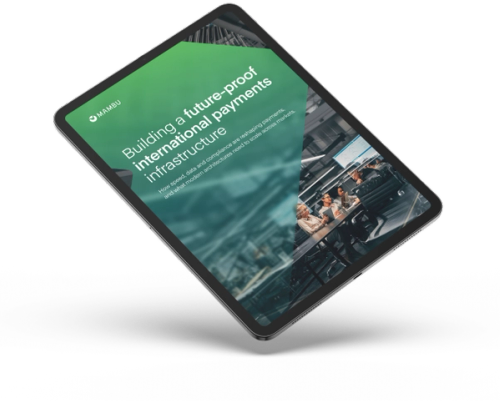
Building a future-proof international payments infrastructure
How speed, data and compliance are reshaping payments
This report explores how real-time payments are removing traditional safety nets. With non-cash volumes forecast to reach 2.8 trillion by 2028, the window for error is fading away. Legacy systems built for a slower world have reached a structural tipping point.

© Mambu 2026